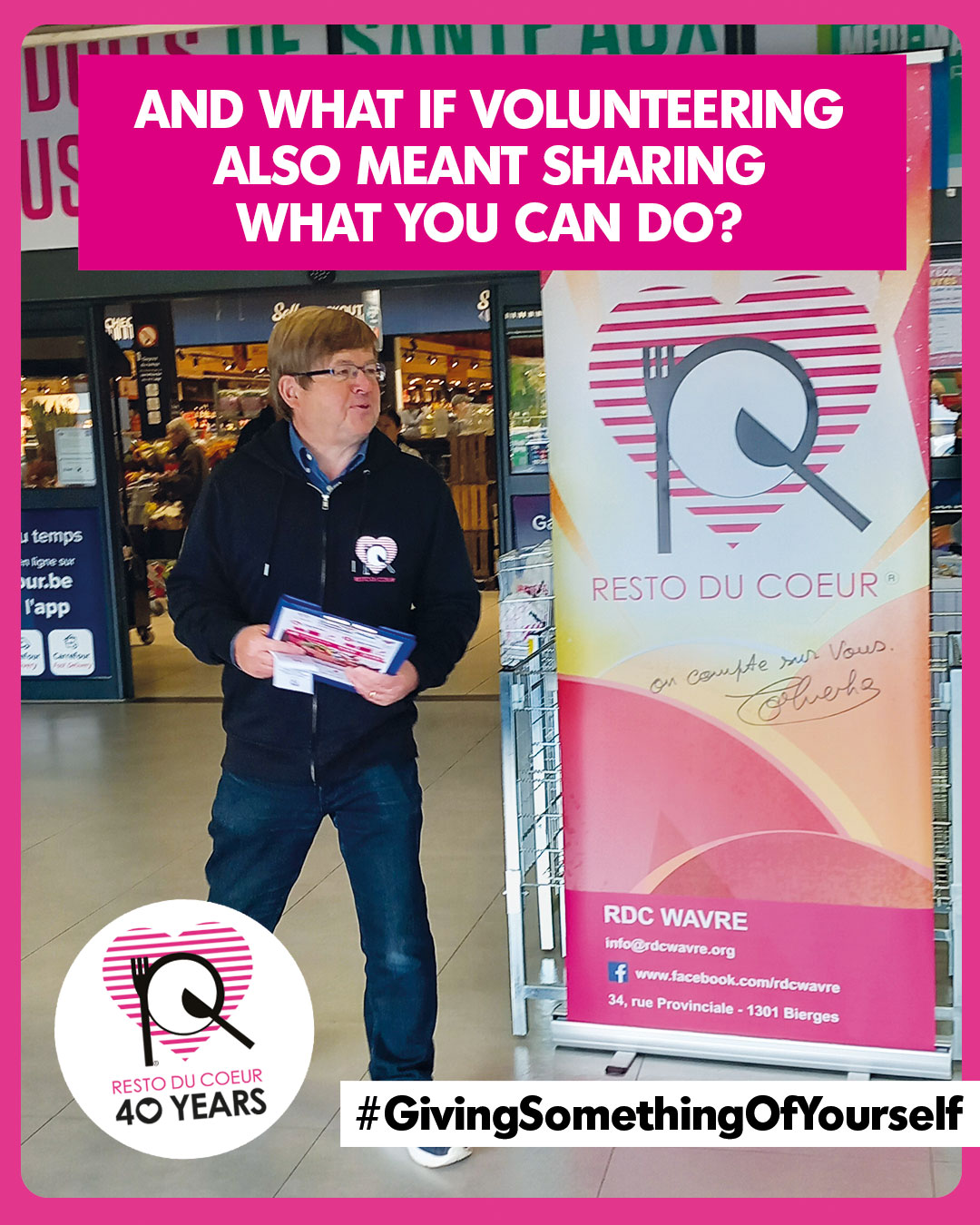
The years pass, and Didier now works as an IT consultant, but the desire to make a difference remains. When he finally decided to offer his help to the Restos du Coeur, he did not wait long before looking for ways to contribute. In point of fact, he was already approaching shops in an effort to recover food products even before officially embarking on his volunteering work.
Even today, Didier is keen to keep Fridays reserved for work in the field, as it were.
Depending on current needs, a day may involve collecting unsold products from partner stores, sorting received goods, packaging food, preparing or distributing food parcels, looking after fruit and vegetables, or standing in for another volunteer who is absent.
But his commitment does not stop there.
His professional background in information technology also enables him to contribute in other ways: monitoring Resto du Coeur statistics, producing charts, developing tools, managing the website, preparing mailshots, handling communications or creating content for social media.
It is a form of volunteering that is sometimes far removed from the image people may have of it.
Because behind every food distribution lies a great deal of unseen work: collecting products, carrying crates, sorting supplies, managing stocks, analysing needs and organising logistics.
Giving of oneself also means putting one’s skills and expertise at the service of a cause.
Didier readily describes himself as being more present behind the scenes than on the front line of welcoming visitors.
And yet human contact naturally finds its place.
Whenever he walks through the Resto du Coeur hall, he tries to exchange a few words with the people he meets. A greeting, a question, a few minutes of conversation.
Sometimes that is where it ends. Sometimes someone begins to talk about what they are going through.
Even when he is in a hurry, Didier tries to take the time to listen.
This gesture does not fill a food parcel and does not appear in any statistics. Yet it highlights another essential aspect of volunteering: being present.
Because someone who walks through the doors of a Resto du Coeur does not simply come looking for food. They also arrive with their own story, their own difficulties and, at times, a need simply to be acknowledged and listened to.
“Things can change very quickly”
Volunteering has also changed the way Didier looks at hardship and vulnerability.
Through the situations he has encountered, he has become particularly aware of how quickly a life can be turned upside down. Bereavement, the loss of a job or an unexpected setback can radically alter, in a matter of months, circumstances that once seemed secure.
This reality challenges many of the assumptions we may hold about people who rely on food aid.
Hardship has no single face, nor does it follow a predetermined path.
For Didier, remaining active in the field every week is also a way of maintaining contact with that reality: seeing, listening to and understanding what the people being supported are actually experiencing.
What does he value most about volunteering? The feeling of having a tangible impact on people’s everyday lives.
A food parcel distributed, a collection of surplus goods organised, an improved tool or a simplified administrative task may each seem like small things when viewed individually. Yet together they enable the Restos du Coeur to fulfil its mission week after week.
Didier sums it up simply:
“It gives meaning to my life, to the time I spend and to the efforts I make.”
Volunteering requires time and energy. Didier is careful not to present an idealised picture of it: some tasks are physically demanding, others repetitive or largely unseen, and the voluntary sector has its own challenges.
Yet it is precisely this diversity that enables everyone to find a way to contribute.
To anyone considering volunteering but still hesitating, Didier's advice is above all to walk through the door and try.
There is no need to fit a particular profile.
Some people prefer direct contact with those receiving support. Others feel more useful in logistics, catering, transport, administration, communications or behind a computer screen.
All of these contributions matter.
Because giving of oneself cannot be measured solely in hours worked.
It is also found in a skill that is shared, a crate that is carried, a journey that is made, an idea that is offered, or a few minutes that one chooses to devote to another person.
And what if you, too, had something to share?