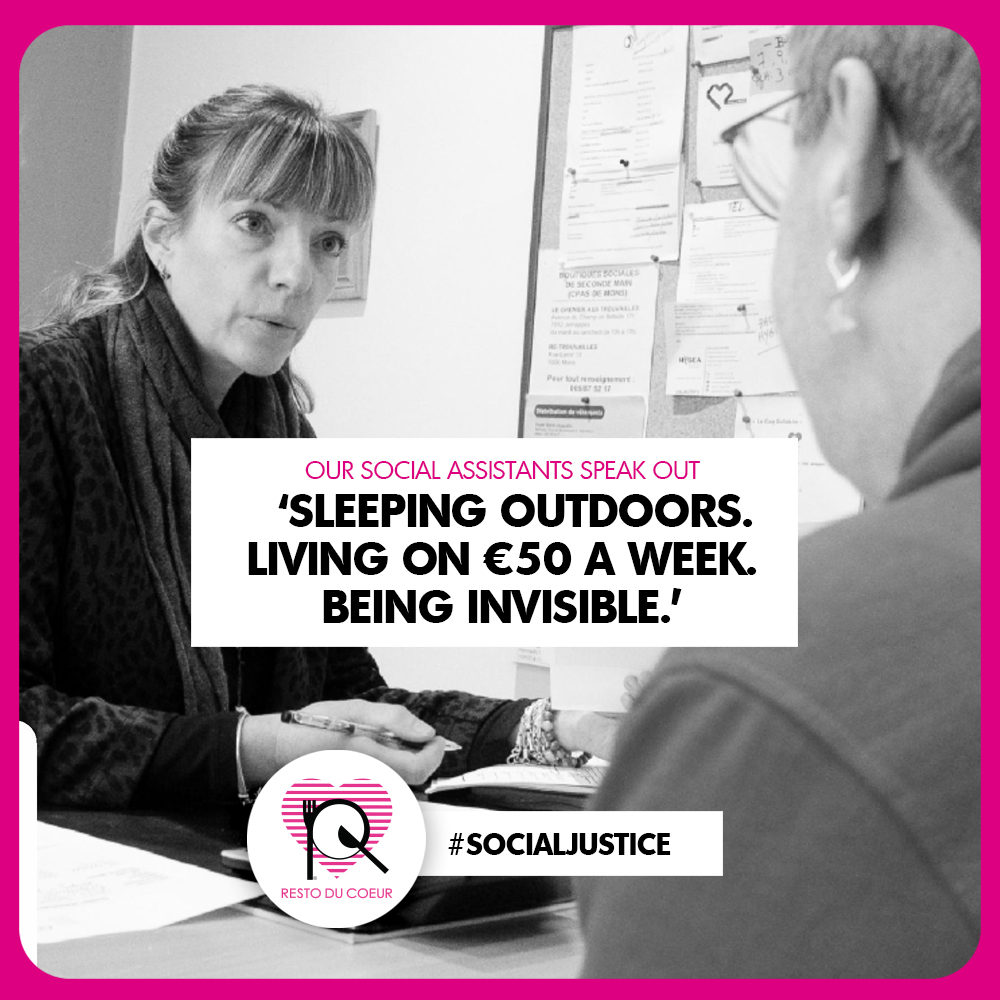
"I always start with the same question: ‘How are you?’ It’s already a way of establishing a connection. The person feels seen as an individual, not just a number. You have to recognise the person in front of you, not just see him or her as a problem." — Margaux
A connection built week by week
"I see people every week. Even if they don’t come for a formal meeting, we still cross paths. This regular interaction makes effective follow-up possible and helps us step in quickly when something isn’t right." — Géraldine
"Our role is also to reassure and guide. We’re not here to do things for people, but to help them understand, organise, and move forward." — Margaux
Simple but essential actions
"Every week, we help read letters, fill out forms, send emails. We make calls to health insurance providers, contact social workers at the CPAS [Public Welfare Agency], or redirect people to specialised support."
"And sometimes, it’s an emergency. We have to act immediately—alert a service, protect a child, find emergency accommodation."
A wide variety of beneficiaries
"We welcome a cross-section of society—people aged 17 to 85, with or without income, with or without qualifications, Belgian or not." — Margaux
"Many of our beneficiaries once led stable lives. A separation, an accident, a business failure… and everything changes." — Géraldine
Complex realities
"The main difficulties we see? Poor housing conditions, homelessness, mental health disorders—often linked to adverse life events like divorce, bereavement, or job loss." — Margaux
"Some people at times have a decent income but are overwhelmed with debt. So even with a salary, they struggle to get by." — Géraldine
Support beyond food aid
"In Mons, we operate as a food shop. People choose their own products. It’s not a pre-packed parcel. This helps preserve their dignity." — Géraldine
Ambitions held back by lack of resources
"We are dreaming of a facility for mother-child workshops, legal clinics, or group activities. But we lack space.” — Géraldine
A call for recognition, solidarity ….and on policymakers
The two professionals also highlight a lack of structural resources for providing dignified support to people facing hardship. For Margaux, it is urgent to "expand access to psychological and psychiatric care, improve access to housing with social assistance, and train professionals and volunteers to approach people without judgement and with compassion."
They also call for greater awareness of the social realities from policymakers. Géraldine asks indignantly: "Is it right that organisations like ours, relying on the work of dozens of volunteers, are always the last resort? That we have to make up for the system’s shortcomings?"
For her part, Margaux is straightforward: "Have you ever tried to live on €50 a week? To sleep rough in winter? To look for a job while living on the streets? These are daily realities."
Their message is clear: change is needed. And it must come from the top.
"Everything can fall apart in a moment. It’s crucial not to judge. Everyone deserves dignity." — Margaux
Faced with a system that fails where it should protect, the social workers of the Restos du Cœur stand firm. They refuse indifference, get the voices of the forgotten heard, and prove, each and every day, that another model is not only possible but urgently needed.