Reality outstrips projects
Since the beginning of 2026, the first people reaching the end of their entitlement to unemployment benefits have been turning to the CPAS. To anticipate the consequences of the reform, the government had worked on the following assumption: one third of those concerned would find employment, one third would rely on the integration income, and one third would have sufficient resources without needing to request assistance.
The Court of Audit had nevertheless warned that the proportion of people shifting to the integration income had "probably been underestimated." [3]
The first official figures confirm as much. For those reaching the end of their entitlement in March 2026, the National Employment Office recorded 37,295 exits from unemployment and 15,530 entries into the integration income, i.e. 41.6 %.
Not one third. More than four in ten. [4]
Behind these percentages are people who remain in precarious situations, even when they disappear from unemployment statistics.
Disappearing from a statistic does not mean escaping poverty.
When resources are no longer sufficient to cover housing, energy, healthcare and daily expenses, food becomes the variable that gives way. It is at this point that people turn to food-aid organisations as the very last resort.
Food precariousness is already deeply entrenched
In the queues, the profiles of those waiting for food aid are diverse: recipients of the integration income, workers in insecure employment, single‑parent families, students, isolated individuals, pensioners… To these already‑present groups are now added new people affected by recent social reforms.
Meanwhile, the teams of volunteers and workers in food aid recover unsold goods, seek partners, purchase missing items, transport, store, prepare and distribute. They adapt constantly. They try to find solutions where they can. They do more and more.
But there are limits.
Needs remain extremely high, but the food supplies are falling.
Public support for food aid is insufficient. A significant portion of previous funding has been reduced or withdrawn. The federal government, which financed essential food purchases at €27 million in 2025, reduced this budget to €15 million in 2026. [5]
This equation cannot possibly hold
On the ground, this means shrinking stocks, additional purchases to finance, parcels that must still be assembled, and associations forced to seek new resources yet again.
Food aid is the last safety net. We cannot continue to weaken it while asking it to support an ever‑growing number of people.
Food aid cannot absorb everything
For years, the sector has compensated for inadequate incomes, unaffordable rents, rising energy bills, healthcare costs and life’s emergencies. Today, it must also absorb the consequences of major social reforms.
How can we respond to a social emergency when resources melt away at the very moment demand surges?
Access to food is a fundamental human right, not a privilege!
Yet the State is retreating from its responsibility, leaving local services overwhelmed and associations to shoulder alone what should be a matter of national solidarity.
26 September: the Empty Plates Line
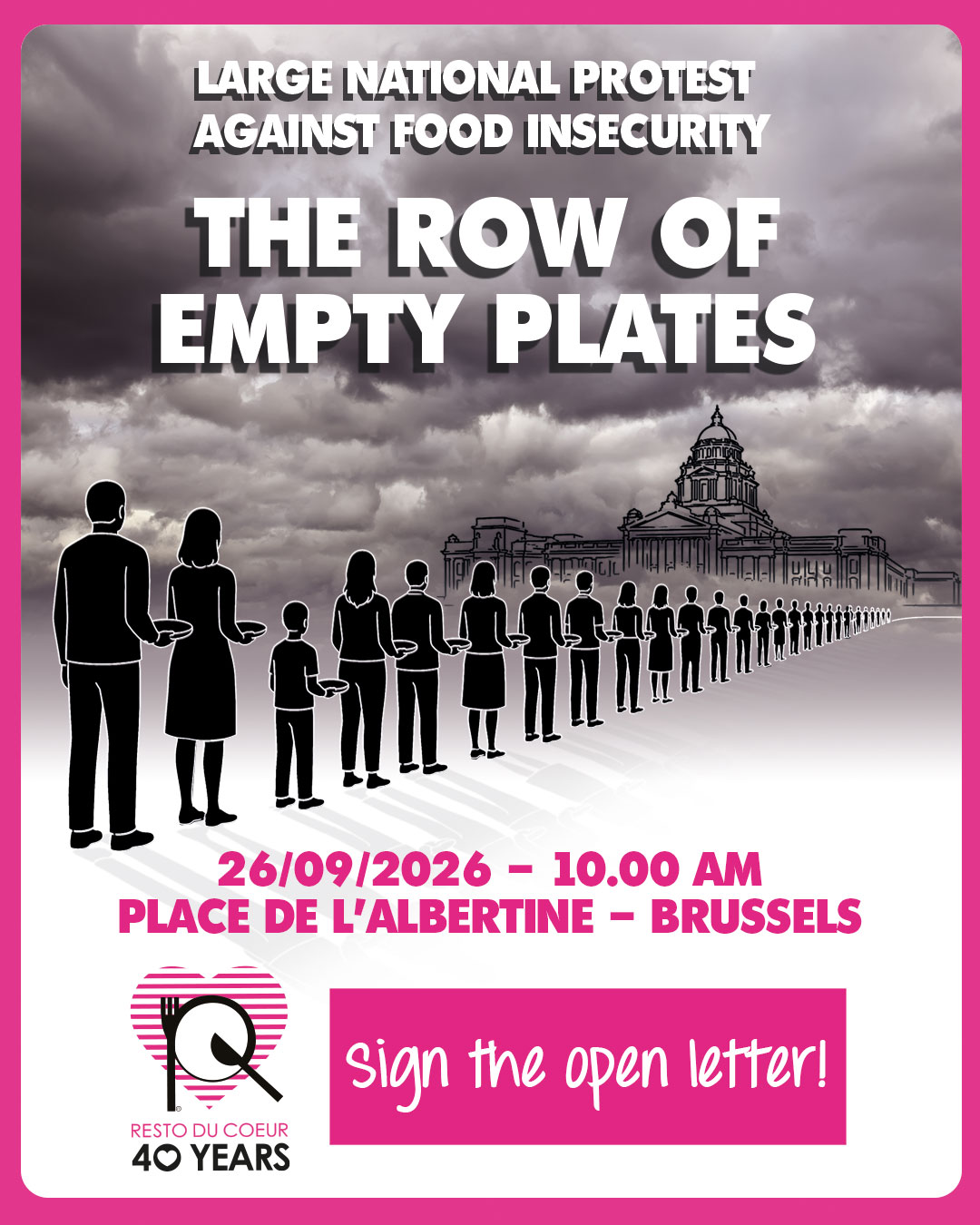
Faced with this situation, the food aid organisations are mobilising. On 26 September 2026, the Resto du Cœur of Belgium Federation is to join the Federation of Social Services and calls on workers and volunteers in food aid and the wider social‑health sector to form the "Empty Plates Line" in Brussels -- a queue to remind us that an empty plate is not a statistic, it is a meal lost.
The way forward:
We call on public authorities to:
- Guarantee the right to food: Ensure that everyone has the means to meet their essential needs, including access to adequate food, in dignity.
- Support and assist the most vulnerable: which implies giving social‑sector workers and volunteers, including those in food aid, the means to carry out their missions.
- Provide food‑aid structures with the resources to face the current emergency: finance the purchase of appropriate food products, support logistical and supply platforms that assist organisations on the ground, and distribute food vouchers to affected populations so they can obtain supplies directly from shops.
Access to food is a fundamental right. No one should have to choose between heating, healthcare and food. No queue of this kind should exist.
On 26 September, we will carry empty plates.
[3] Comments and observations on the draft State budgets for the 2026 financial year, February 2026.
[4] National Employment Office: "The National Employment Office publishes the second monitoring report on exits from unemployment following the reform", 2 July 2026.
[5] Belgian House of Representatives, reply by the Minister for Social Integration Anneleen Van Bossuyt, 11 February 2026