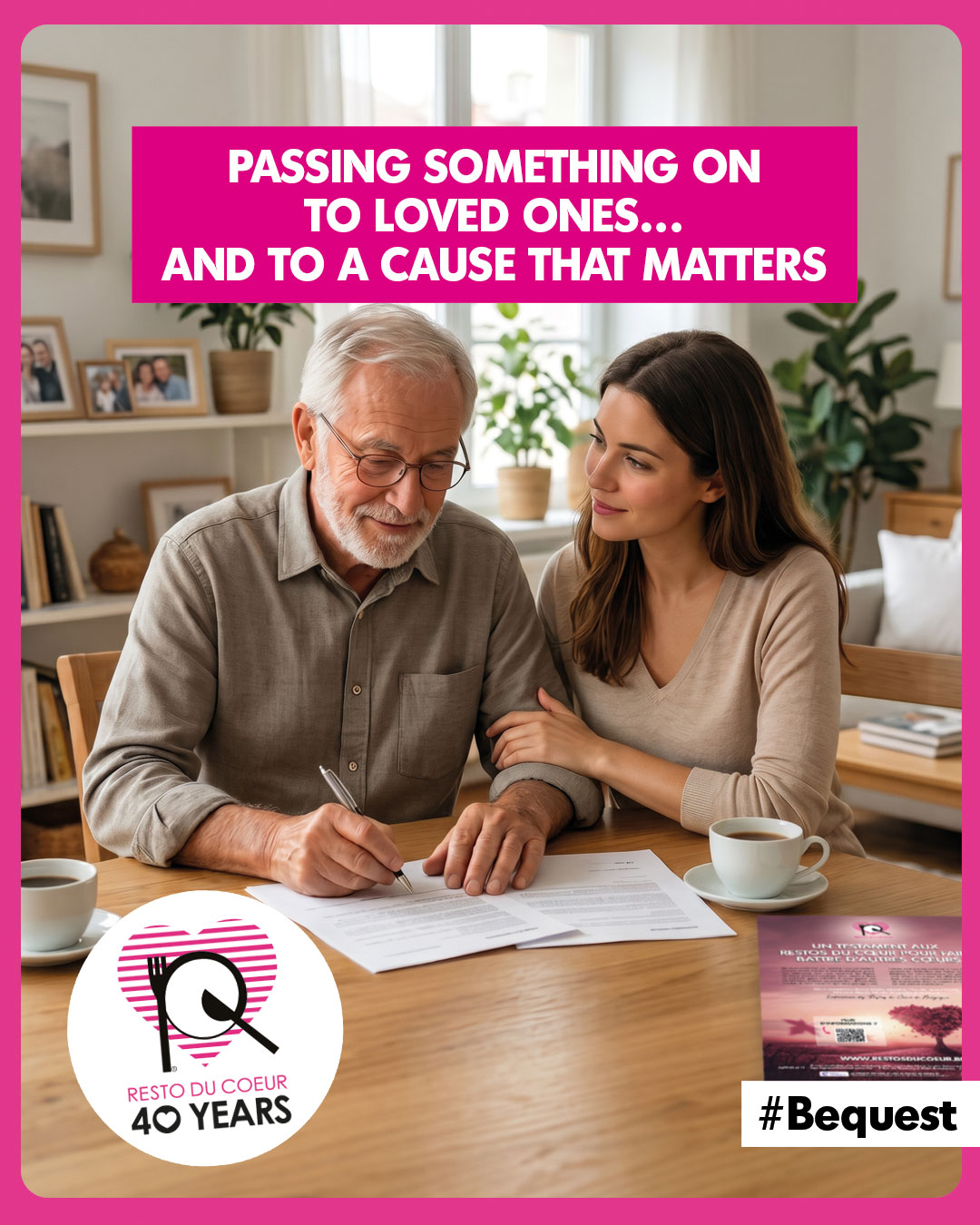
This is the case for Frederick, aged 43, whose testimony was collected by testament.be. A family man, he wishes his children to inherit a large part of his estate. At the same time, he would like a portion of it to benefit less fortunate people through organisations working on their behalf.
For him, this decision also carries a message:
“It is equally important to me that they should be willing to share some of it with organisations and people who are less fortunate than they are financially.”
In his view, this is a way of passing on to his children a particular understanding of solidarity and, perhaps, inspiring them in turn to support charitable causes.
Belgian inheritance law makes it possible to reconcile these different wishes.
The Federation of Notaries (Fednot) points out that children collectively benefit from a minimum share protected by law: the reserved portion of the estate. This represents half of the estate, regardless of the number of children.
The other half, subject in particular to any rights of a surviving spouse, is the portion that may be freely disposed of by will.
This does not, of course, mean that the whole of it must be left to a charitable organisation.
A legacy may relate to a specific sum of money, a particular asset or a proportion of the estate. Everyone remains free to decide what best suits their family circumstances, wishes and means.
Because every situation is different, Fednot recommends consulting a notary when planning one’s estate or including a charitable cause in a will.
The debate is, moreover, gaining ground in Belgium.
According to the study published in 2025 by HOGENT, nearly one-third of Belgians who already support charitable causes would like to, or are considering, including one in their will.
However, the step from intention to action remains limited: only 4 % have already formalised such a decision in a will, while a further 5 % say they intend to do so.
This also illustrates how easily the subject of making a will is postponed.
Discussing one’s estate is never a trivial matter. It compels us to reflect on what we will leave behind, whom we wish to protect, and how we would like what we have built to be used once we are gone.
For the Resto du Coeur of Belgium Federation, legacies contribute to the continuity of our work.
They help provide long-term support for the four pillars around which the assistance offered by the 21 Restos du Coeur centres is organised: food aid, educational support, housing assistance and healthcare support.
Making a legacy in favour of the Restos du Coeur therefore does not necessarily mean choosing between one’s family and a cause.
It may simply mean deciding that, alongside what is passed on to loved ones, a part of one’s story will continue to support those who need it most.
Because an inheritance can pass on material assets.
But it can also keep alive the values that have guided us throughout our lives.